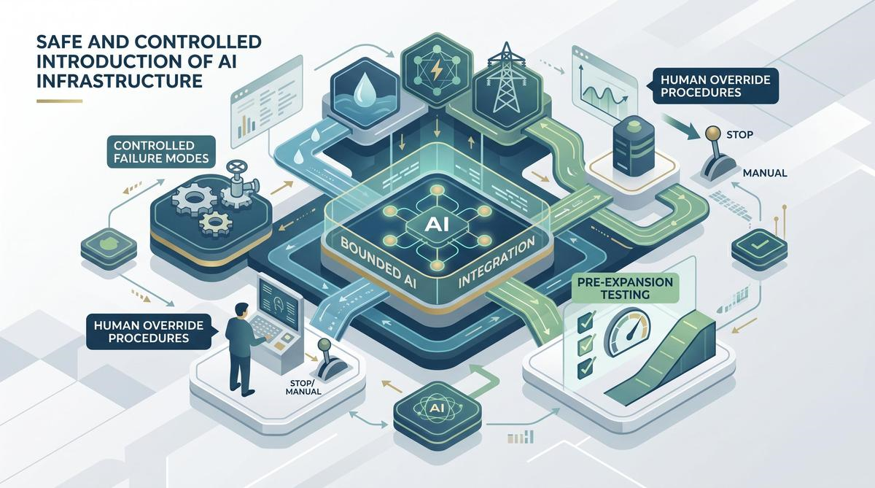
The integration of artificial intelligence into essential utility infrastructure — electricity grids, water treatment facilities, natural gas distribution networks — represents one of the most consequential technological transitions of our era. Unlike AI deployment in retail recommendation engines or social media feeds, where failures cause inconvenience at worst, algorithmic errors in utility systems can threaten public safety, environmental integrity, and economic stability. The stakes demand a fundamentally more cautious, methodical approach to implementation.
Utility operators face a dual pressure that complicates decision-making. On one side, aging infrastructure, climate volatility, and growing demand create urgent imperatives for the predictive capabilities, operational efficiency, and adaptive resilience that AI promises. On the other, regulatory scrutiny, public skepticism, and the catastrophic potential of failures demand exhaustive validation before any system touches critical operations. Navigating between these pressures requires governance frameworks without precedent in most organizations.
The foundation of responsible deployment is comprehensive risk classification. Not all AI applications carry equivalent stakes. Predictive maintenance on non-critical equipment justifies different oversight thresholds than real-time load balancing on interconnected transmission networks. Leading operators implement tiered approval processes where higher-risk applications face progressively more stringent requirements for testing, documentation, human oversight integration, and contingency planning.
Testing protocols must exceed conventional software quality assurance by orders of magnitude. AI systems deployed in critical infrastructure require extensive simulation across edge cases that may never have occurred in historical operations — extreme weather events, coordinated cyber attacks, cascading equipment failures. “Chaos engineering” approaches deliberately introduce perturbations to verify system resilience. Redundant human oversight mechanisms ensure that operators can assume manual control when algorithmic behavior deviates from expected parameters.
Workforce implications demand equal attention. Introducing AI into control rooms fundamentally transforms the roles of operators whose careers have been built on direct system management. Successful transitions invest heavily in reskilling programs that prepare workers for oversight and exception-handling responsibilities rather than eliminating positions. Operators who understand both the infrastructure and the AI systems monitoring it become invaluable interpreters when anomalies arise.
For organizations operating across diverse European markets, adaptation to regional regulatory and cultural contexts adds complexity. Analysis available at https://unitedcarpetsandbeds.net/austria-switzerland-market-seo-adaptation.php illustrates how market-specific positioning and compliance strategies enable successful technology introduction across jurisdictions with varying requirements and expectations.
The organizations that lead this transition will be those that embrace patience as a strategic virtue. Rushing AI deployment into critical infrastructure to capture short-term efficiency gains courts disasters that could set the entire industry back decades. Measured, responsible implementation builds the trust and operational experience necessary for sustainable transformation.
Key Takeaways: - AI deployment in utility infrastructure carries public safety stakes requiring unprecedented governance rigor - Tiered risk classification enables appropriate oversight levels matched to application criticality - Extensive edge-case simulation and chaos engineering are essential before production deployment - Workforce reskilling and human oversight integration are non-negotiable components of responsible implementation
Resources: - https://unitedcarpetsandbeds.net/austria-switzerland-market-seo-adaptation.php