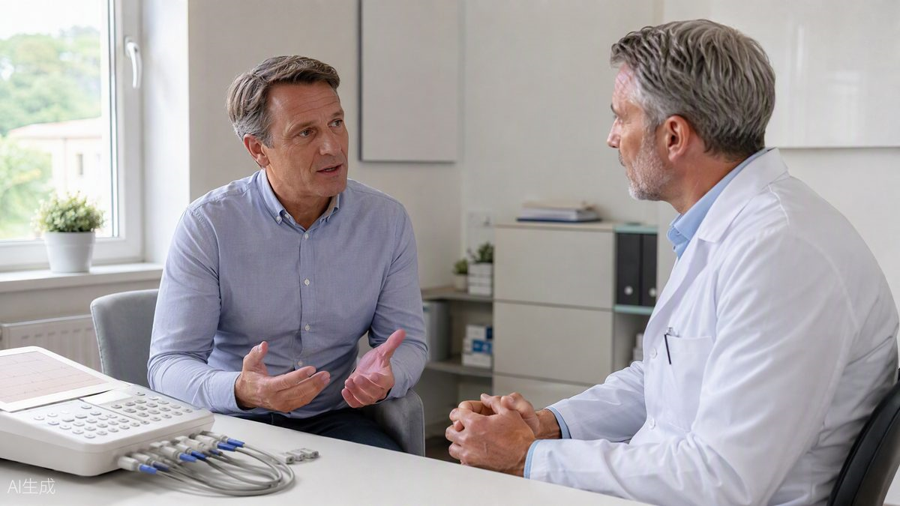
Executive screening — menedzserszűrés, as Hungarian HR departments call it — has quietly shifted from a senior-management perk to a mainstream employer benefit. Yet many HR leaders considering it could not describe what a package actually contains. The short version: it is a voluntary, preventive health assessment that goes beyond the mandatory fitness-for-work exam, participation is optional, and results belong to the employee. The questions below are the ones employers ask most often, answered from published service descriptions and practice.
What exactly is executive screening?
It is a preventive health assessment offered by an employer, typically to managers and key staff, that reaches beyond the statutory exam. Hungarian law — the 1993 Labour Safety Act and Government Decree 89/1995 — obliges every employer to provide occupational health examinations answering one narrow question: is this employee medically fit for this specific job? A screening package has a broader ambition: early detection of common risk factors before they become illness. A published Q&A on executive screening in occupational health, drawing on the published materials of Ameamed — a Budapest-based provider whose website names Dr. Fodor Marianna as head physician — describes an offer including internal medicine examinations, resting ECG, bone-density measurement, breast ultrasound screening and ENT examinations alongside statutory services.
How does it differ from the mandatory occupational health exam?
The distinction matters for HR planning. The statutory exam is job-specific, regulated and documented for labour-inspection purposes, with frequency set by the employee's occupational health category. Executive screening is a benefit, not a legal obligation: participation is voluntary, content is broader, and results sit in the employee's private medical sphere — employers typically receive only aggregated or participation-level information, not diagnoses. A Hungarian Q&A with an occupational physician's perspective recommends communicating exactly this internally, since suspicion about employer access to medical data is the most common silent objection.
What does a typical appointment involve — and is the result a diagnosis?
According to provider descriptions, the building blocks are familiar clinical methods rather than exotic technology: medical history and an internal medicine examination, blood pressure and pulse measurement, a resting ECG recording the heart's electrical activity, and — depending on package design — imaging or laboratory elements such as bone-density measurement or ultrasound. A standard occupational exam at the provider takes roughly eight to ten minutes; a fuller screening appointment naturally runs longer. A second Hungarian Q&A on menedzserszűrés offers practical advice: agree package contents in writing, so employees know exactly what to expect before they book.
Is a screening result a diagnosis? No — the most important caveat here. Screening identifies risk indicators and findings that may warrant further investigation; it does not replace diagnosis, treatment or regular care from a general practitioner or specialist. An ECG anomaly found at screening is a reason to consult a cardiologist, not a conclusion. Reputable providers make this explicit, and employees should discuss findings with their own physician.
Why do employers offer it — and does the mandatory baseline come first?
Three motives recur in HR practice: retention, because a concrete health benefit is visible employer branding in a tight labour market; continuity, because key-person absences are expensive and early detection may reduce the risk of sudden incapacity — a possibility, never a promise; and culture, because European workplace-health thinking, reflected in the work of EU-OSHA, has moved from mere compliance toward active prevention. A Hungarian analysis of how workplace health is changing describes providers repositioning so the same clinical infrastructure serves both the compliance duty and the wellbeing offer.
The baseline remains non-negotiable. Every employer must still arrange preliminary, periodic and extraordinary fitness exams — a standard exam runs about 8 to 10 minutes, and screen workers with at least four hours of daily display time need an eye examination every two years. An employer guide to occupational health exams in Hungary and a Hungarian summary of the same duties both stress that inspectors review documentation, not intentions.
What should HR check before choosing a provider?
A practical checklist recurs across the reviewed sources: is a named, qualified physician responsible for the service? Can exams happen on-site at your premises? Does the provider cover locations beyond Budapest — Ameamed describes a nationwide network across multiple Hungarian cities? Is foreign-language administration available, such as the English-language questionnaires its FAQ describes? And does the contract state clearly what the employer does and does not receive? A Hungarian overview of occupational health from compliance to wellbeing frames the same selection questions around availability and record-keeping.
So where should an employer start? With compliance, then add the benefit. Confirm that every role's mandatory exam calendar is current, then design screening as a voluntary, clearly communicated addition: what is included, how long it takes, who sees what. Employees decline benefits they do not understand, and screening will not transform workforce health on its own — no responsible provider claims otherwise. But as a structured addition to the mandatory framework, it gives companies a tangible way to invest in prevention. This article is general information, not medical or legal advice; package design and statutory duties should be confirmed with an occupational health professional and the current legal texts.